
Free shipping from €90 in Spain Mainland and Balearic Islands | 48-72h



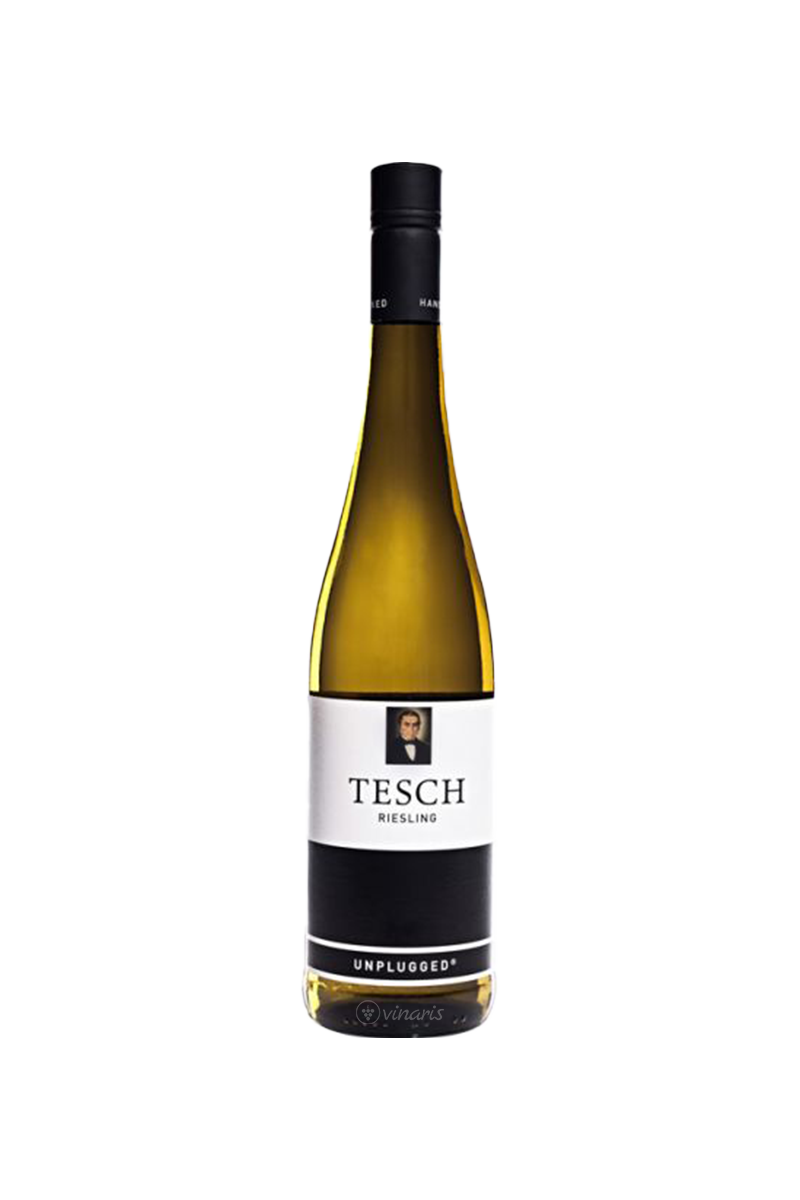
 Martin Tesch represents the eleventh generation of his family in Langenlonsheim on the Nahe, and since taking over the estate in 1996 — armed with a PhD in microbiology — he has reshaped it around a rigorous no-herbicide, no-insecticide, no-mineral-fertiliser philosophy, with all fruit brought in by hand and no external certification sought. Unplugged sits in the middle of the Tesch range, an assemblage drawn from multiple parcels, sitting between the entry-level 'T' and the five individual single-vineyard bottlings; Tesch describes it as 'markant und supertrocken' — emphatic in character and uncompromisingly dry.
 The 2023 is bottled trocken at 12.5% ABV, the lightest point in the Tesch lineup. The Nahe's characteristic racy, mineral-edged acidity provides structure and freshness.

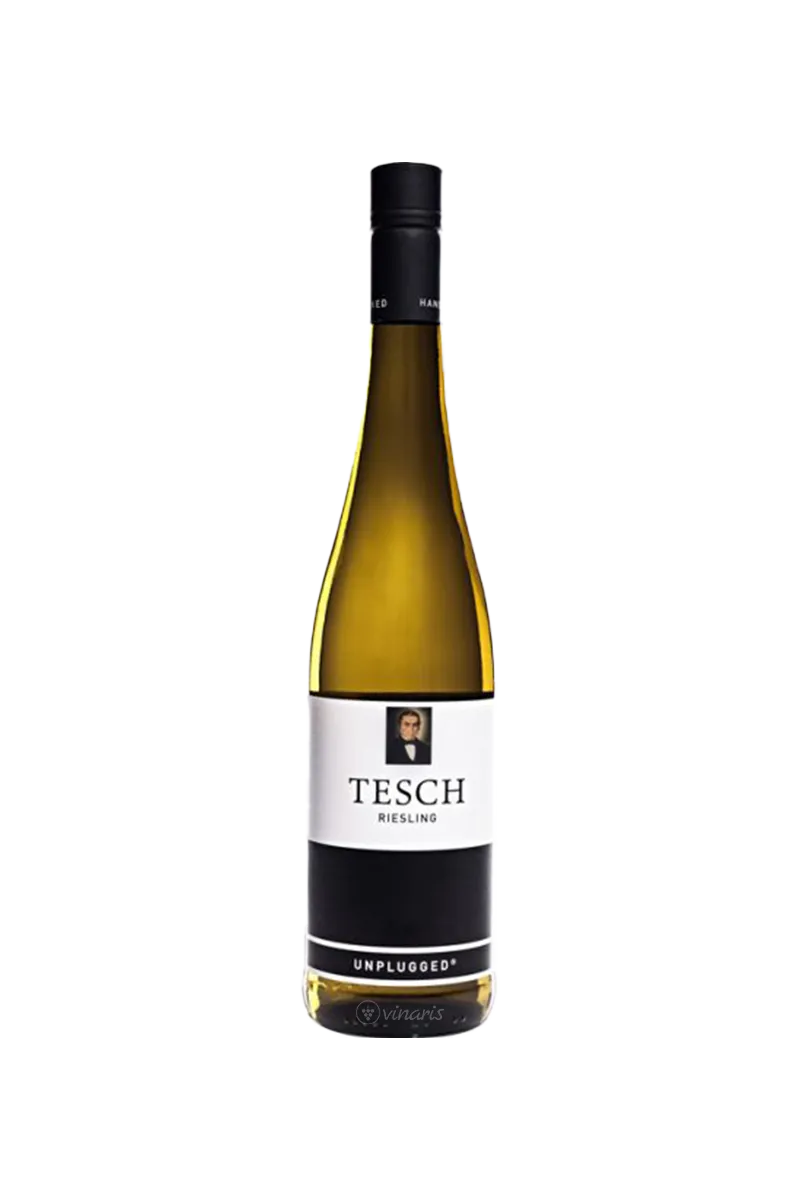
Unplugged 2023, Weingut Tesch
Este vino es un Riesling blanco de la añada 2023, producido por la bodega alemana Weingut Tesch. La finca está en Langenlonsheim, en el corazón de la región del Nahe. La uva es exclusivamente Riesling.
La bodega lleva once generaciones en la zona. Desde que Martin Tesch, doctor en microbiología, asumió la gestión en 1996, la propiedad adoptó una filosofía propia: abandonó el VDP en 2014 y trabaja sin herbicidas, insecticidas ni abonos minerales, realizando toda la vendimia de forma manual. Unplugged es un ensamblaje de múltiples parcelas de la finca, situándose en la segunda gama de la bodega, por encima del vino de entrada «T» pero por debajo de sus cinco Rieslings de viñedo individual. El productor define el estilo como «markant und supertrocken», es decir, marcado y súper seco.
La fermentación de esta añada se realiza en seco (trocken), resultando en un 12,5% de alcohol, la graduación más contenida de toda la gama de la bodega. La acidez tensa y mineral, típica de la región del Nahe, aporta estructura y frescura al conjunto.
En cuanto a valoración, Parker otorgó 92 puntos y James Suckling 93 puntos.
Se trata de un blanco de carácter marcado y muy seco, donde la mineralidad y la acidez definen su perfil, ofreciendo una estructura contenida en alcohol propia de la identidad actual de la bodega en el Nahe.
Descripción generada por IA con conocimiento WSET. Solo orientativa.
The farmstead that is today Weingut Tesch has belonged to the family since 1723, when Johannes Matthess appears as its first winemaker, and eleven generations later it is still in Langenlonsheim, on the banks of the Nahe. The turning point came in 1996, when Martin Tesch —a PhD microbiologist— took over from his father Helmut, inheriting just over 30 hectares and a conventional catalogue spanning several varieties and every level of sweetness.
What he did next was subtract. In 2002 he reorganised the estate completely: he dropped the sweet wines, cut the range to three varieties —Riesling, Spätburgunder and Weißburgunder— and eleven wines, all dry, and shrank the vineyard to its current 20 hectares, 17 of them Riesling. Twelve years later came the second step: in May 2014 he left the VDP, the association of Germany's elite growers. The official statement said the goals of the VDP and those of the estate had drifted too far apart.
He farms five Einzellagen with deliberately contrasting soils: Löhrer Berg on damp clay and river gravels, Krone between calcareous loess and weathered sandstone, Königsschild with shell fossils in chalk and wind-blown loess, Karthäuser on weathered iron-rich sandstone, and St. Remigiusberg on volcanic soils. Each site is bottled separately and always dry, so that what you taste is the difference between soils rather than between methods: fermentation in small stainless steel tanks, no oak, spontaneous malolactic, no chaptalisation, and screwcaps since 2005.
That is where his best-known name comes from. "Riesling Unplugged" is, in his own words, like those unplugged music sessions: without amplification. The analogy stopped being a metaphor in 2008, when he sent a few bottles of that wine to Die Toten Hosen. The punk band liked it enough to turn up at the winery and end up making their own: they meet in the vineyard each year to choose the lots, and the result is called Weißes Rauschen —after a song from their album "Zurück zum Glück"— carrying the band's eagle on the label. It was not the first: before it there was a Machmalriesling.
See all wines by Weingut Tesch →