



Free shipping from €90 in Spain Mainland and Balearic Islands | 48-72h


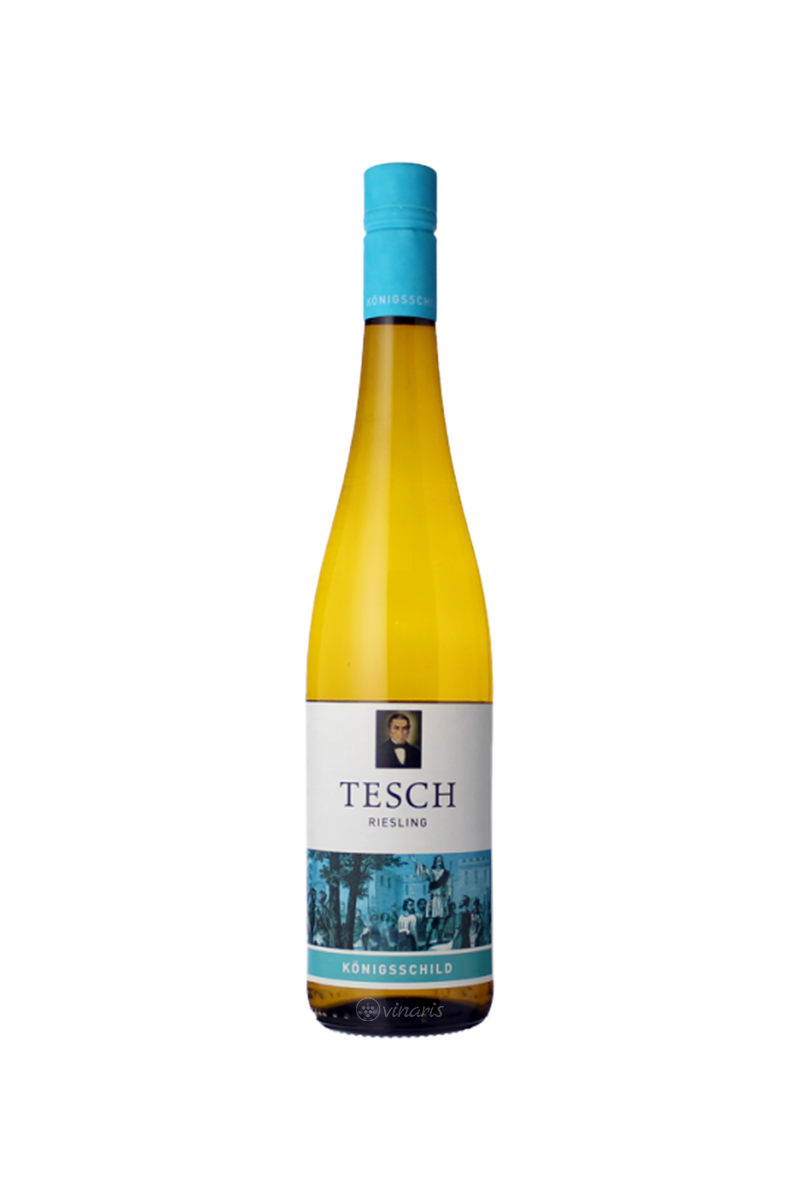
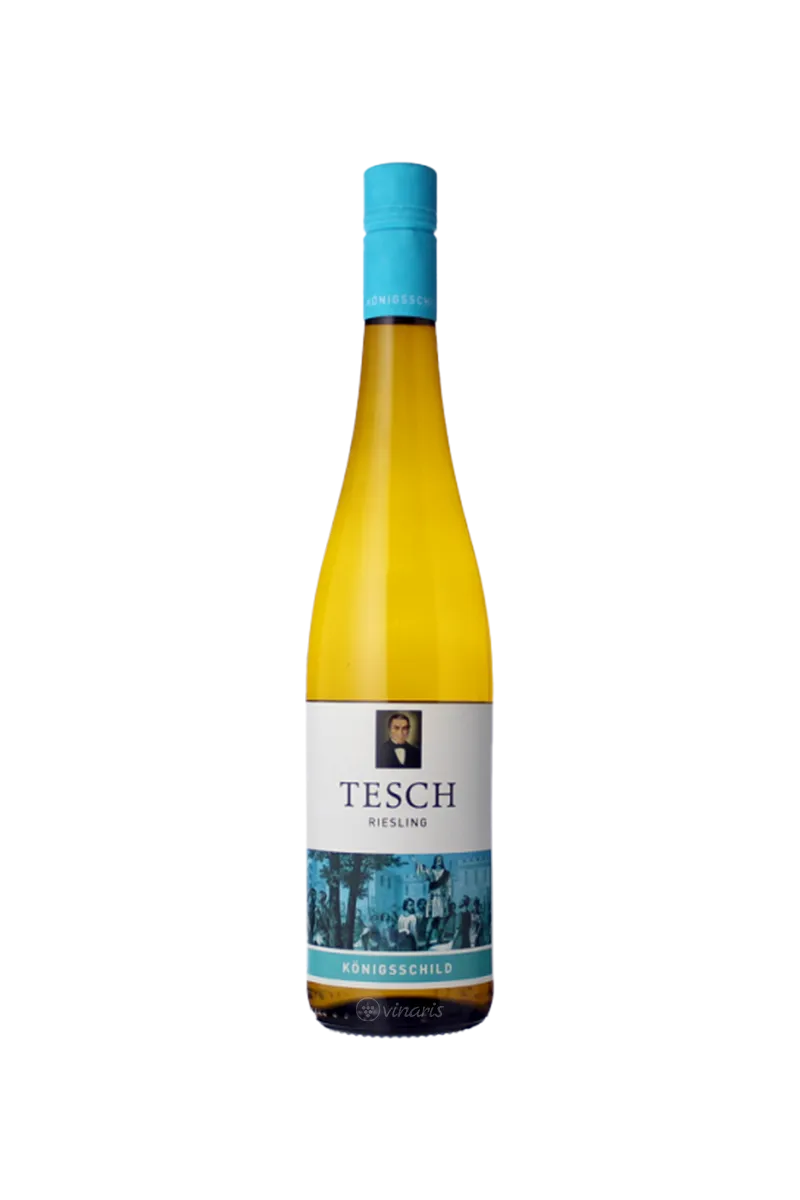
 Weingut Tesch has been based in Langenlonsheim on the Nahe for eleven generations; Martin Tesch, who holds a PhD in microbiology, took over and restructured the estate in 2002, farming without herbicides, insecticides, or mineral fertilisers and harvesting entirely by hand, with no third-party certification. The Langenlonsheimer Königsschild Einzellage takes its name from the near-parabolic shape of the parcel — 'like a king's shield' — and its calcareous loess-loam over Tertiary shell limestone with clay is geologically distinct from the Permian red sandstone (Rotliegendes) of Tesch's Karthäuser.
 The 2023 Königsschild is a dry (trocken) Riesling at 13% ABV, with 3.2 g/L residual sugar and 6.7 g/L total acidity. Relative to the more structured, spice- and mineral-driven Karthäuser and St. Remigiusberg, Königsschild consistently shows a creamier, more citrus-oriented character.
Identificación
El Königsschild 2023 es un vino blanco elaborado por la bodega Weingut Tesch en el Nahe. Procedente de Alemania, la añada corresponde al año 2023.
Procedencia y Elaboración
La bodega se ubica en Langenlonsheim, en las orillas del río Nahe, y es dirigida desde 1996 por Martin Tesch, doctor en microbiología. La gestión vitivinícola se realiza sin herbicidas, insecticidas ni abonos minerales, combinando vendimia manual con la ausencia de certificaciones externas o de la organización VDP. El vino proviene de la Einzellage Langenlonsheimer Königsschild, una parcela de forma casi parabólica orientada al sur-sureste, situada entre 140 y 210 metros de altitud. El suelo se compone de loess-loam calcáreo sobre caliza de concha terciaria con arcilla, lo que permite que las raíces profundicen hasta quince metros. La uva utilizada es 100% Riesling. La cosecha 2023 produce un vino trocken (seco) con un 13,0% de alcohol, 3,2 g/L de azúcar residual y 6,7 g/L de acidez total.
Perfil
Este Riesling se caracteriza por un perfil más cremoso y cítrico en comparación con otros vinos de la bodega como el Karthäuser o el St. Remigiusberg, que presentan notas más estructuradas y especiadas.
Puntuaciones y Críticos
Carácter General
El Königsschild 2023 ofrece una expresión de la uva Riesling en Langenlonsheim, marcada por su cremosidad y acidez equilibrada, fruto de un terroir específico de loess y caliza.
The farmstead that is today Weingut Tesch has belonged to the family since 1723, when Johannes Matthess appears as its first winemaker, and eleven generations later it is still in Langenlonsheim, on the banks of the Nahe. The turning point came in 1996, when Martin Tesch —a PhD microbiologist— took over from his father Helmut, inheriting just over 30 hectares and a conventional catalogue spanning several varieties and every level of sweetness.
What he did next was subtract. In 2002 he reorganised the estate completely: he dropped the sweet wines, cut the range to three varieties —Riesling, Spätburgunder and Weißburgunder— and eleven wines, all dry, and shrank the vineyard to its current 20 hectares, 17 of them Riesling. Twelve years later came the second step: in May 2014 he left the VDP, the association of Germany's elite growers. The official statement said the goals of the VDP and those of the estate had drifted too far apart.
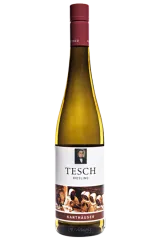
He farms five Einzellagen with deliberately contrasting soils: Löhrer Berg on damp clay and river gravels, Krone between calcareous loess and weathered sandstone, Königsschild with shell fossils in chalk and wind-blown loess, Karthäuser on weathered iron-rich sandstone, and St. Remigiusberg on volcanic soils. Each site is bottled separately and always dry, so that what you taste is the difference between soils rather than between methods: fermentation in small stainless steel tanks, no oak, spontaneous malolactic, no chaptalisation, and screwcaps since 2005.
That is where his best-known name comes from. "Riesling Unplugged" is, in his own words, like those unplugged music sessions: without amplification. The analogy stopped being a metaphor in 2008, when he sent a few bottles of that wine to Die Toten Hosen. The punk band liked it enough to turn up at the winery and end up making their own: they meet in the vineyard each year to choose the lots, and the result is called Weißes Rauschen —after a song from their album "Zurück zum Glück"— carrying the band's eagle on the label. It was not the first: before it there was a Machmalriesling.
See all wines by Weingut Tesch →