Free shipping from €90 in Spain Mainland and Balearic Islands | 48-72h


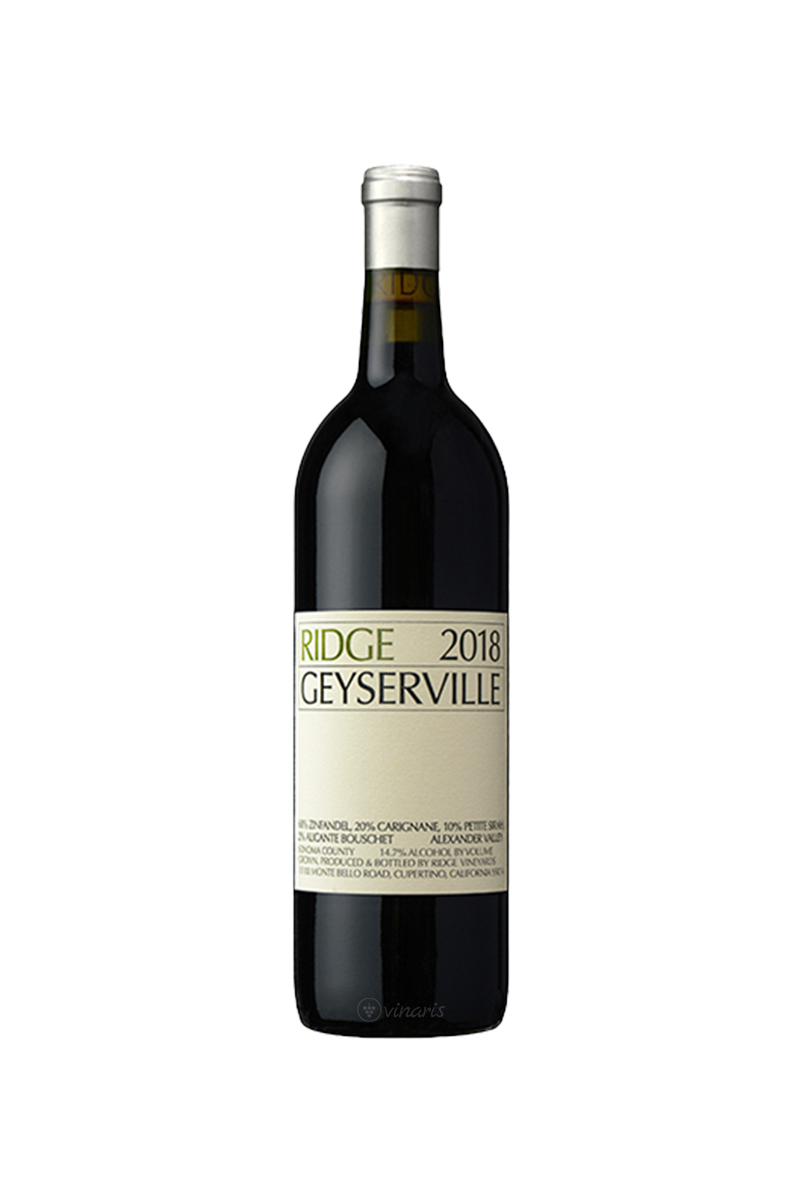
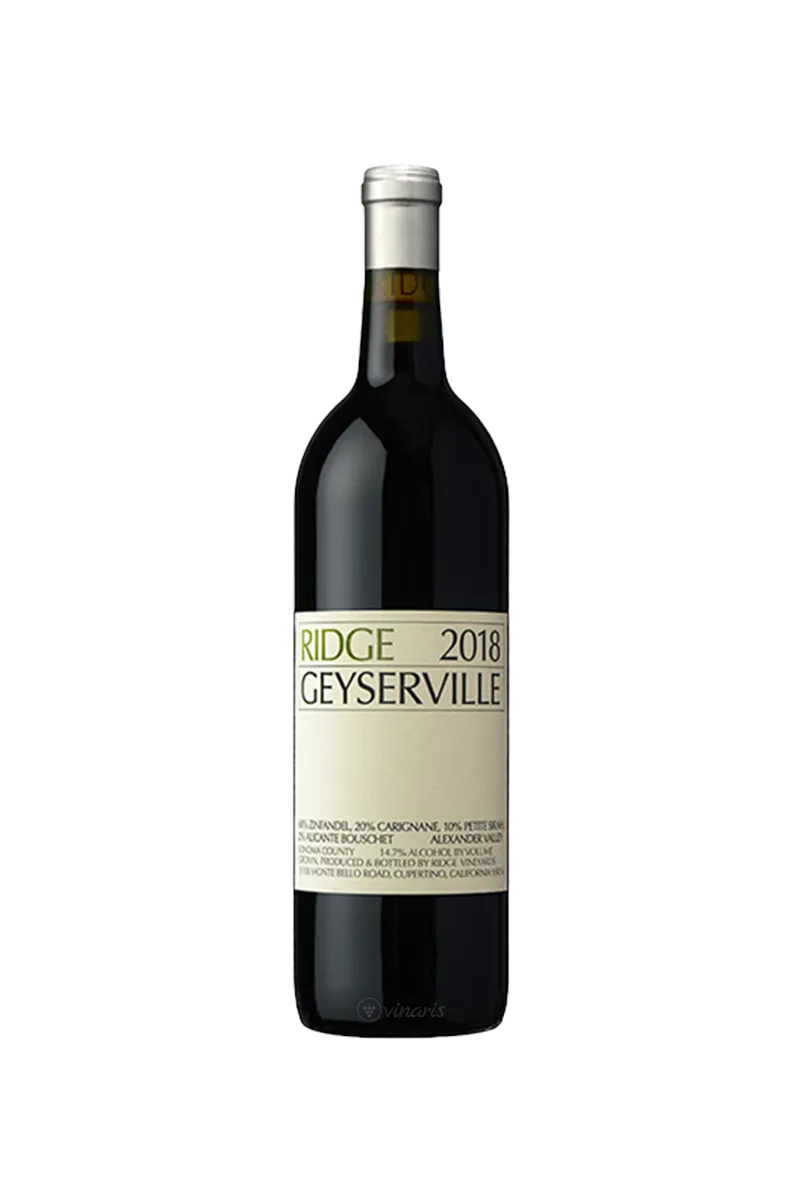
 Ridge Vineyards, Alexander Valley, Sonoma County, California. A blend of 68% Zinfandel, 20% Carignane, 10% Petite Sirah and 2% Alicante Bouschet from three adjoining vineyards on gravelly soils. Hand-harvested.
 Destemmed and crushed. Natural primary and malolactic fermentations. Daily pump-overs; pressed at 8 days. Aged 13 months in American oak barrels (11% new, 42% one to two years old, 47% three to four years old).

El Geyserville 2018 es un vino tinto elaborado por Ridge Vineyards en Estados Unidos, bajo la denominación de California. Procede del valle de Alexander, en el condado de Sonoma. Las uvas proceden de tres viñedos contiguos situadas sobre suelo pedregoso.
La vinificación sigue un proceso tradicional: se realiza vendimia manual, seguida de despalillado y estrujado. Las fermentaciones alcohólica y maloláctica ocurren de forma natural. Durante la elaboración se realizan remontados diarios y el vino se prensa a los ocho días de maceración. Para la crianza, se utilizan barricas de roble americano durante 13 meses, con una composición de 11% de barricas nuevas, 42% de una a dos años de uso y 47% de tres a cuatro años.
La composición de la uva es una mezcla de 68% Zinfandel, 20% Carignane, 10% Petite Sirah y 2% Alicante Bouschet. Según la evaluación de Robert Parker, el vino obtuvo una puntuación de 96 puntos. En su análisis, describe el aroma como increíblemente atractivo, con capas de frutas tricolores cálidas, acentos especiados abundantes y un subtexto polvoriento y mineralizado. En boca se presenta generosamente frutal y jugoso, con taninos finos como el limo que ofrecen el soporte adecuado y un final muy largo y complejo. Se produjeron 9.900 cajas de esta añada.
Descripción generada por IA con conocimiento WSET. Solo orientativa.
PARKER: 96
The 2018 Geyserville is a blend of 68% Zinfandel, 20% Carignane, 10% Petite Sirah and 2% Alicante Bouschet. It's incredibly alluring, offering up layers of warm, tricolored fruits and loads of spicy accents on the nose, with a dusty, mineral-tinged undercurrent that adds to its appeal. In the mouth, it's generously fruited and fantastically juicy, its silt-like tannins providing just enough support, and it finishes very long and layered. 9,900 cases produced.
In 1885 Osea Perrone, a doctor and a prominent member of San Francisco's Italian community, bought 180 acres (73 ha) near the top of Monte Bello Ridge, at 2,600 feet —792 metres— above the bay. He terraced the slope, planted vines and used limestone quarried on the mountain to build the winery that gave the wine its name: the first vintage under the Monte Bello label is from 1892.
The estate was reborn seventy years later, and in a distinctly un-winemaking way. Four Stanford Research Institute engineers —Dave Bennion, Hew Crane, Charlie Rosen and Howard Ziedler— made a quarter-barrel of Cabernet from the old vines still standing. It convinced them enough to re-bond the winery in time for the 1962 harvest. In 1966 they bottled the first Geyserville Zinfandel, and in 1969 Paul Draper joined, raised on a farm outside Chicago and drawn to wine after living in Italy and France. He was the estate's winemaker for forty-seven years, retiring in 2016 at eighty.
He described his own method as pre-industrial: native yeasts from the vineyard itself, minimal sulfur, and not a single commercial enzyme or nutrient. The house rule fits in one line —find intense fruit, intrude only when necessary— and it explains the quirk Ridge is best known for outside the trade: since 2011 it prints the full ingredient list on the back label, something no regulation required and almost nobody did.
The proof came twice. At the 1976 Judgment of Paris, the 1971 Monte Bello placed fifth. Thirty years later, on 24 May 2006, those same bottles were re-tasted: the 1971 won both the United States and United Kingdom panels and, in the combined result, finished eighteen points clear of the runner-up.
In Sonoma the story runs longer than ownership suggests: Ridge has made Geyserville since 1966 —from vines over 130 years old— and has worked Lytton Springs since 1972, though the property only became theirs in 1991. Since 2022 every estate vineyard is certified organic.
See all wines by Ridge Vineyards →