

Free shipping from €90 in Spain Mainland and Balearic Islands | 48-72h



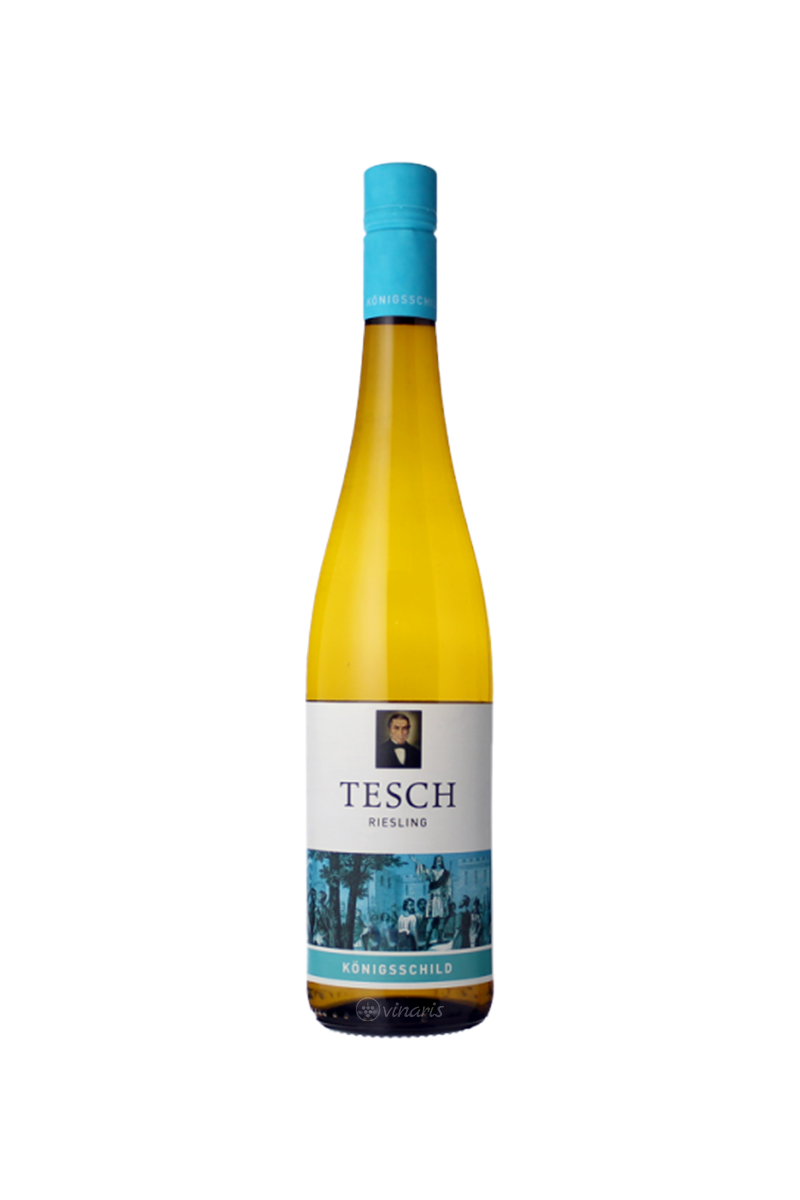
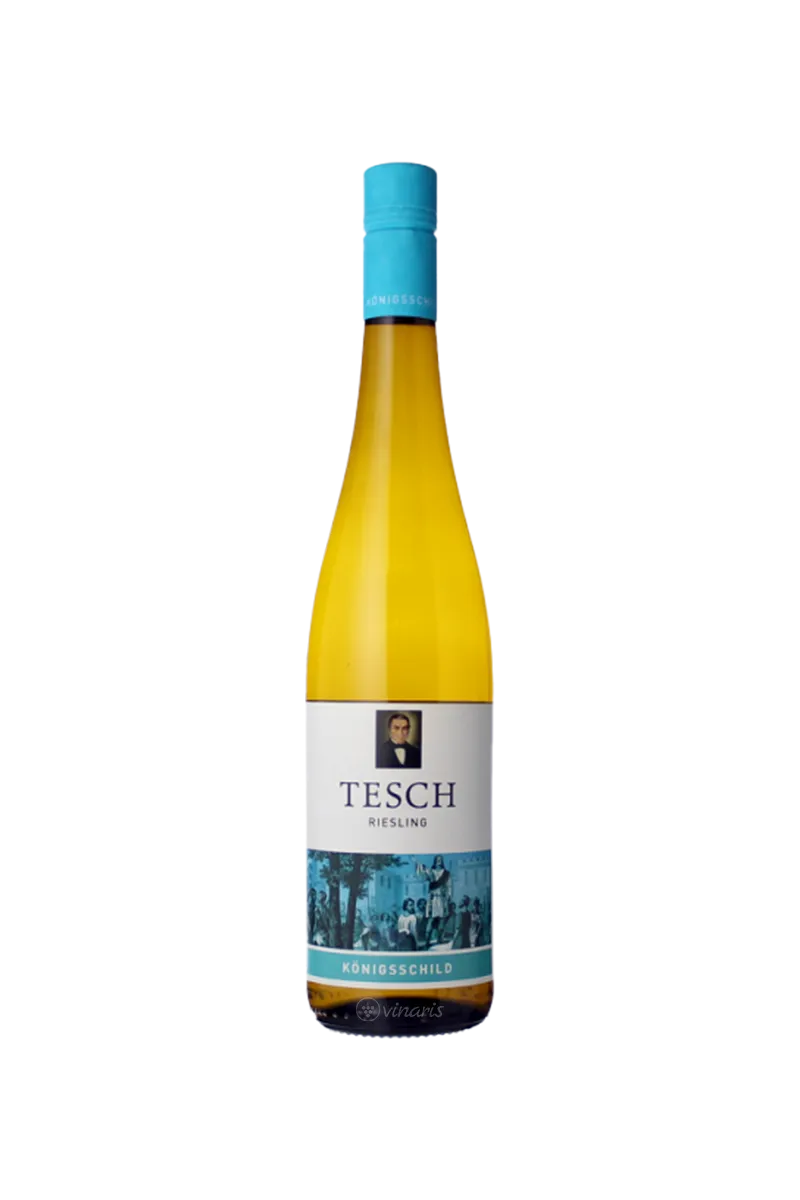
 Weingut Tesch has been based in Langenlonsheim on the Nahe for eleven generations; Martin Tesch, who holds a PhD in microbiology, took over in 1996 and restructured the estate in 2002, farming without herbicides, insecticides, or mineral fertilisers and harvesting entirely by hand, with no VDP membership or third-party certification. The Langenlonsheimer Königsschild Einzellage takes its name from the near-parabolic shape of the parcel — 'like a king's shield' — and its calcareous loess-loam over Tertiary shell limestone with clay is geologically distinct from the Permian red sandstone (Rotliegendes) of Tesch's Karthäuser.
 The 2023 Königsschild is a dry (trocken) Riesling at 13% ABV, with 3.2 g/L residual sugar and 6.7 g/L total acidity. Relative to the more structured, spice- and mineral-driven Karthäuser and St. Remigiusberg, Königsschild consistently shows a creamier, more citrus-oriented character.

Ficha del Vino: Königsschild
Descripción generada por IA con conocimiento WSET. Solo orientativa.
The farmstead that is today Weingut Tesch has belonged to the family since 1723, when Johannes Matthess appears as its first winemaker, and eleven generations later it is still in Langenlonsheim, on the banks of the Nahe. The turning point came in 1996, when Martin Tesch —a PhD microbiologist— took over from his father Helmut, inheriting just over 30 hectares and a conventional catalogue spanning several varieties and every level of sweetness.
What he did next was subtract. In 2002 he reorganised the estate completely: he dropped the sweet wines, cut the range to three varieties —Riesling, Spätburgunder and Weißburgunder— and eleven wines, all dry, and shrank the vineyard to its current 20 hectares, 17 of them Riesling. Twelve years later came the second step: in May 2014 he left the VDP, the association of Germany's elite growers. The official statement said the goals of the VDP and those of the estate had drifted too far apart.
He farms five Einzellagen with deliberately contrasting soils: Löhrer Berg on damp clay and river gravels, Krone between calcareous loess and weathered sandstone, Königsschild with shell fossils in chalk and wind-blown loess, Karthäuser on weathered iron-rich sandstone, and St. Remigiusberg on volcanic soils. Each site is bottled separately and always dry, so that what you taste is the difference between soils rather than between methods: fermentation in small stainless steel tanks, no oak, spontaneous malolactic, no chaptalisation, and screwcaps since 2005.
That is where his best-known name comes from. "Riesling Unplugged" is, in his own words, like those unplugged music sessions: without amplification. The analogy stopped being a metaphor in 2008, when he sent a few bottles of that wine to Die Toten Hosen. The punk band liked it enough to turn up at the winery and end up making their own: they meet in the vineyard each year to choose the lots, and the result is called Weißes Rauschen —after a song from their album "Zurück zum Glück"— carrying the band's eagle on the label. It was not the first: before it there was a Machmalriesling.
See all wines by Weingut Tesch →