

Free shipping from €90 in Spain Mainland and Balearic Islands | 48-72h



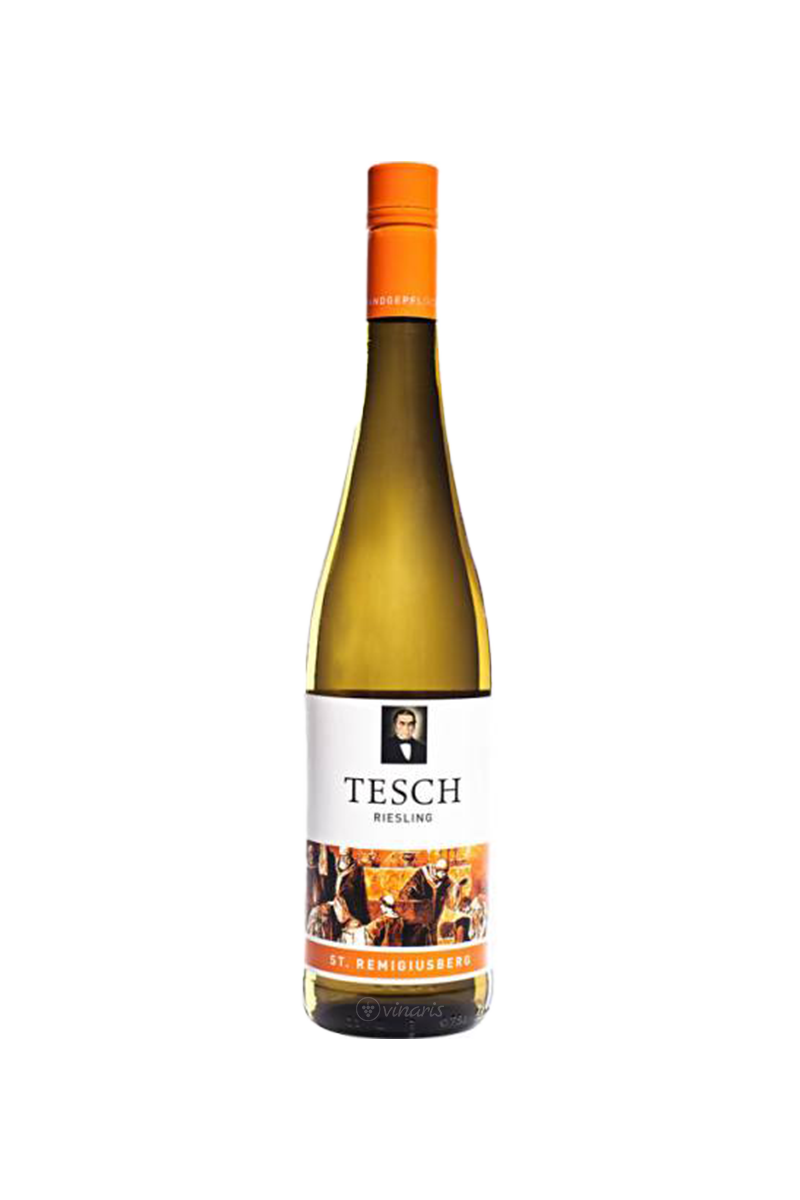
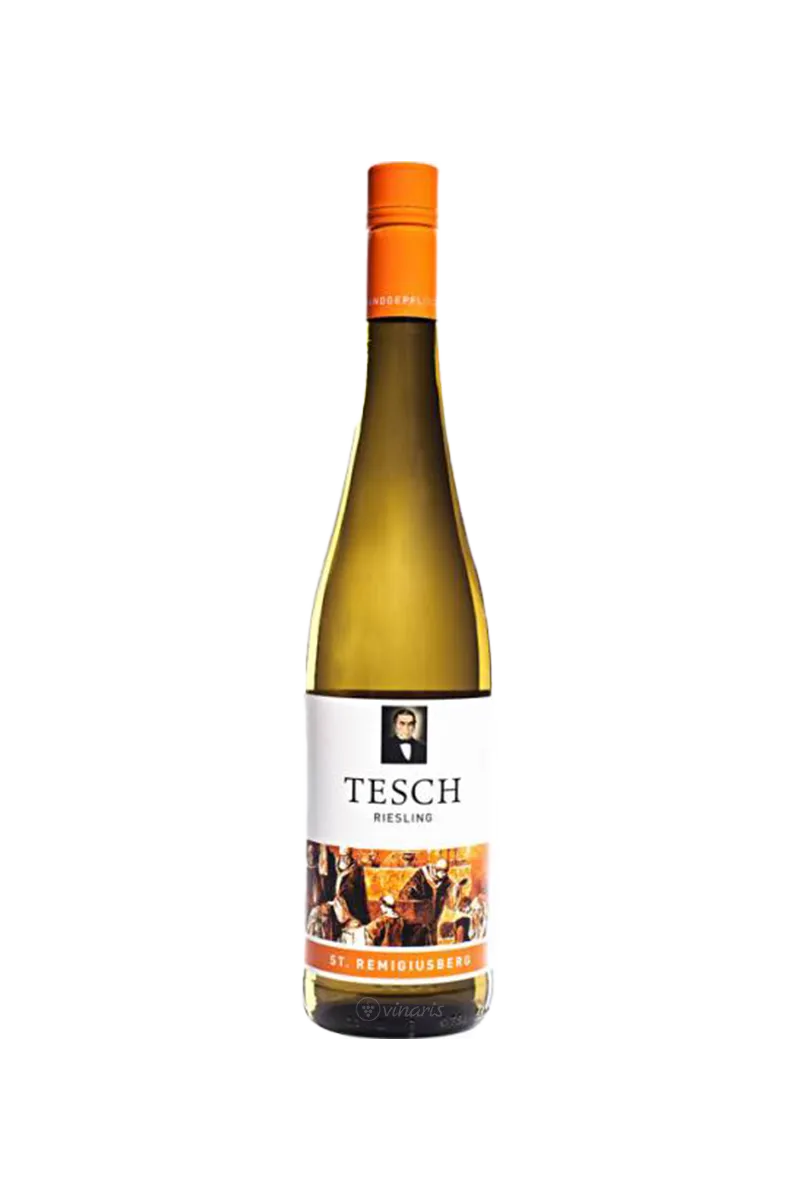
 Weingut Tesch (Martin Tesch), Nahe, Langenlonsheim. St. Remigiusberg single vineyard on volcanic soils of weathered rock and iron-rich clay. Hand-harvested. 100% Riesling.
 Fermented with a pied de cuve to cultivate indigenous yeasts. Extended lees ageing.

El Saint Remigiusberg Riesling Tesch 2019 es un Riesling de Weingut Tesch, dirigida por Martin Tesch, situada en Langenlonsheim, dentro de la denominación de origen Nahe en Alemania. Proviene exclusivamente de la uva Riesling.
La producción se realiza en un viñedo singular, St. Remigiusberg, caracterizado por suelos volcánicos formados por roca meteorizada y arcillas ricas en hierro. La vendimia se realiza completamente a mano. En bodega, el mosto se fermenta utilizando pie de cuba con el fin de cultivar levaduras autóctonas. Tras la fermentación, el vino realiza una crianza prolongada sobre las lías antes de su embotellado.
En cata, según la descripción del crítico Parker, este vino muestra un aroma claro, puro, fresco y con matices ahumados y de pedernal. En boca se presenta rico, intenso, muy elegante, fino y de una viveza vibrante. Se define como un Riesling lineal, refinado y tenso, con un gran agarre y tensión mineral en su final, que es apretado y salino. El crítico destaca que la añada 2019 representa a Tesch en su perfección. Aunque se recomienda encarecidamente, se aconseja paciencia, ya que el vino necesita varios años para alcanzar su punto óptimo de desarrollo.
El vino ha recibido puntuaciones destacadas: 94 puntos por Robert Parker y 95 puntos por James Suckling. Es una elaboración de gran carácter mineral y potencial de guarda que refleja con precisión las condiciones volcánicas de su lugar de origen.
Descripción generada por IA con conocimiento WSET. Solo orientativa.
PARKER: 94
From volcanic soils, the 2019 Riesling St. Remigiusberg is clear, pure, fresh and smoky/flinty on the warm and coolish, delicate and fruity nose. Rich, intense, very elegant, finessed and vibrantly piquant on the palate, this is a linear, refined and tensioned Riesling with enormous grip and mineral tension on the tight and stimulatingly salty finish. This 2019 is Tesch in perfection. Highly recommended, but be patient: this wine needs several years to reach its peak. Tasted as a sample in May and from the bottle in June 2020.
The farmstead that is today Weingut Tesch has belonged to the family since 1723, when Johannes Matthess appears as its first winemaker, and eleven generations later it is still in Langenlonsheim, on the banks of the Nahe. The turning point came in 1996, when Martin Tesch —a PhD microbiologist— took over from his father Helmut, inheriting just over 30 hectares and a conventional catalogue spanning several varieties and every level of sweetness.
What he did next was subtract. In 2002 he reorganised the estate completely: he dropped the sweet wines, cut the range to three varieties —Riesling, Spätburgunder and Weißburgunder— and eleven wines, all dry, and shrank the vineyard to its current 20 hectares, 17 of them Riesling. Twelve years later came the second step: in May 2014 he left the VDP, the association of Germany's elite growers. The official statement said the goals of the VDP and those of the estate had drifted too far apart.
He farms five Einzellagen with deliberately contrasting soils: Löhrer Berg on damp clay and river gravels, Krone between calcareous loess and weathered sandstone, Königsschild with shell fossils in chalk and wind-blown loess, Karthäuser on weathered iron-rich sandstone, and St. Remigiusberg on volcanic soils. Each site is bottled separately and always dry, so that what you taste is the difference between soils rather than between methods: fermentation in small stainless steel tanks, no oak, spontaneous malolactic, no chaptalisation, and screwcaps since 2005.
That is where his best-known name comes from. "Riesling Unplugged" is, in his own words, like those unplugged music sessions: without amplification. The analogy stopped being a metaphor in 2008, when he sent a few bottles of that wine to Die Toten Hosen. The punk band liked it enough to turn up at the winery and end up making their own: they meet in the vineyard each year to choose the lots, and the result is called Weißes Rauschen —after a song from their album "Zurück zum Glück"— carrying the band's eagle on the label. It was not the first: before it there was a Machmalriesling.
See all wines by Weingut Tesch →