

Free shipping from €90 in Spain Mainland and Balearic Islands | 48-72h



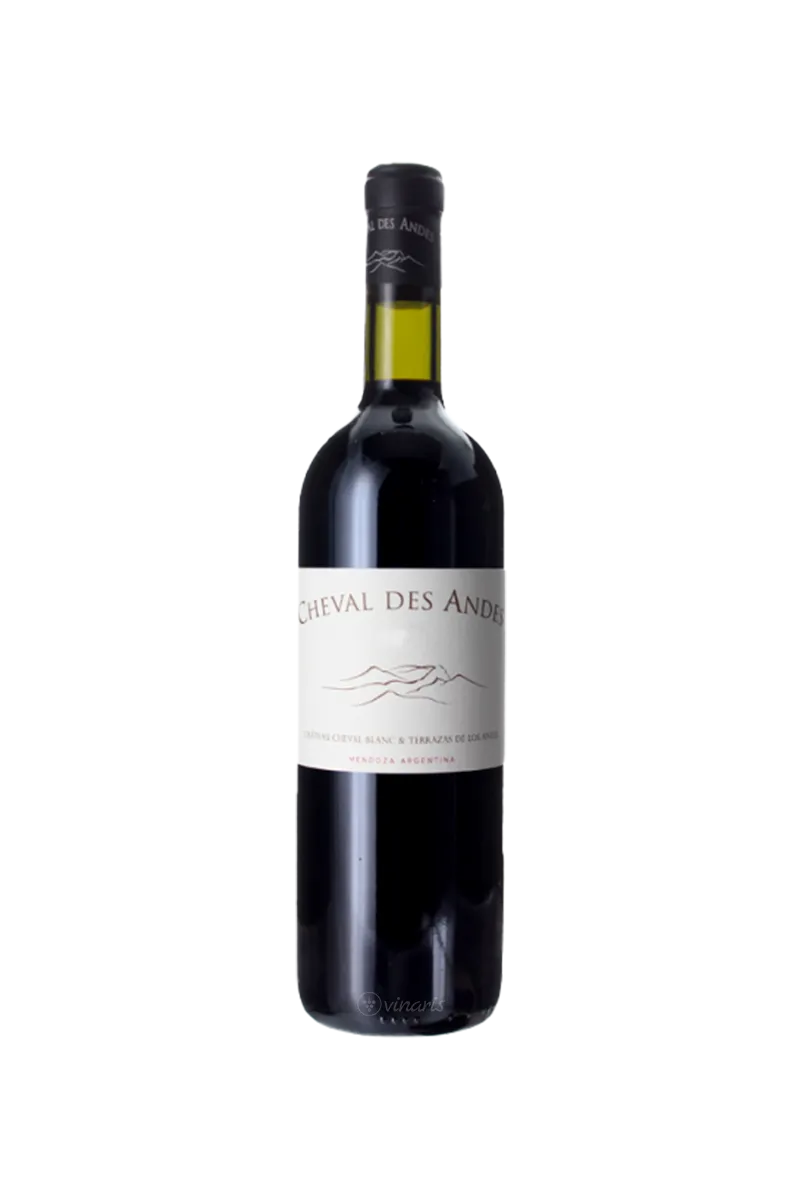
 Cheval des Andes, Mendoza (Argentina). Joint project of Château Cheval Blanc (1er Grand Cru Classé A, Saint-Émilion) and Terrazas de los Andes. 47 ha of vineyards in Las Compuertas (Luján de Cuyo) and Paraje Altamira (Uco Valley), at the foot of the Andes.
 70% Malbec, 30% Cabernet Sauvignon. Vinified in small 80-hl stainless steel tanks. Aged 14 months in Central France oak barrels: 70% new, 30% one year old.

Wine Identification
Cheval des Andes 2018 is a premium red wine from Mendoza, Argentina. Produced by the eponymous winery, this vintage is a collaborative project between Château Cheval Blanc, a Premier Grand Cru Classé A from Saint-Émilion, and Terrazas de los Andes. The grapes are sourced from specific parcels in Las Compuertas (Luján de Cuyo) and the Paraje Altamira (Valle de Uco), totaling 47 hectares of vineyard.
Origin and Winemaking
The blend consists of 70% Malbec and 30% Cabernet Sauvignon. In 2018 it was fermented in small lots in 3,000- to 8,000-liter tanks and matured for 13 months: 40% in 225-liter barrels, 40% in 400-liter barrels and 20% in 2,500-liter vats. Ninety percent of the oak was French, and 50% of it new. The resulting wine has an alcohol content of 14.5% vol.
Expected Profile
The 2018 vintage is described as young, juicy, elegant, and balanced. It exhibits herbal and toasted notes, presenting a medium to full body with a creamy, luxurious texture characteristic of modern Bordeaux-style wines. The palate features very fine tannins and concludes with a long, dry, and precise finish. As a cooler vintage in Mendoza, the wine displays improved freshness and elegance without sacrificing structural power or clout.
Critical Reception
The Wine Advocate (Parker) awarded this wine 98 points, noting that 2018 was one of the best recent vintages in Mendoza. It highlights the wine’s pH of 3.73 and its ability to maintain intensity while showing refined elegance. James Suckling also awarded 98 points.
Overall Character
Cheval des Andes 2018 represents a high-caliber expression of Argentine viticulture, combining French winemaking expertise with Mendoza’s terroir. It is a structured yet approachable wine that balances youthful vibrancy with the complexity derived from extended oak aging.
Descripción generada por IA con conocimiento WSET. Solo orientativa.
PARKER: 98
The 2018 Cheval des Andes is a blend of 70% Malbec and 30% Cabernet Sauvignon fermented in small lots in 3,000- to 8,000-liter tanks and matured 40% in 225-liter oak barrels, 40% in 400-liter oak barrels and the remaining 20% in 2,500-liter oak vats for 13 months. Ninety percent of the oak used was French and the rest a blend of Austrian, Slovenian and German oak, 50% of it new. 2018 has been one of the best vintages in recent times in Mendoza, and the wine shows it. It's a cooler vintage, and the wine has improved in freshness and elegance without losing any clout. It's 14.5% alcohol and has a pH of 3.73. This is young, juicy, elegant and balanced and still has some herbal and toasted notes; it's medium to full-bodied, with the creamy and luxurious texture of the modern Bordeaux, ultra fine tannins and a long, dry and precise finish. It's still undeveloped and seems to have all the components and the balance between them for a long and positive development in bottle. With wines like this, I sometimes wish I had a time machine so I could see them in 20 years from now... I think this is the finest Cheval des Andes I've ever tasted. 100,000 bottles produced. It was bottled in January 2020.
The estate was born in 1999 from an agreement between Château Cheval Blanc, of Saint-Émilion, and Terrazas de los Andes. The reason for the journey was very specific: Pierre Lurton, president of Cheval Blanc, was looking for ungrafted Malbec.
That explains everything else. Phylloxera wiped out French Malbec in the 1860s, and what was replanted afterwards was grafted onto American rootstock. Argentina kept its own material as it was, on its own roots, so Lurton went to the one place where Malbec from before that break still stood.
He found it at Las Compuertas, in Luján de Cuyo, a vineyard planted in 1929. Today the estate covers forty-seven hectares split between those parcels and smaller holdings in Paraje Altamira, in the Uco Valley.
See all wines by Cheval des Andes →