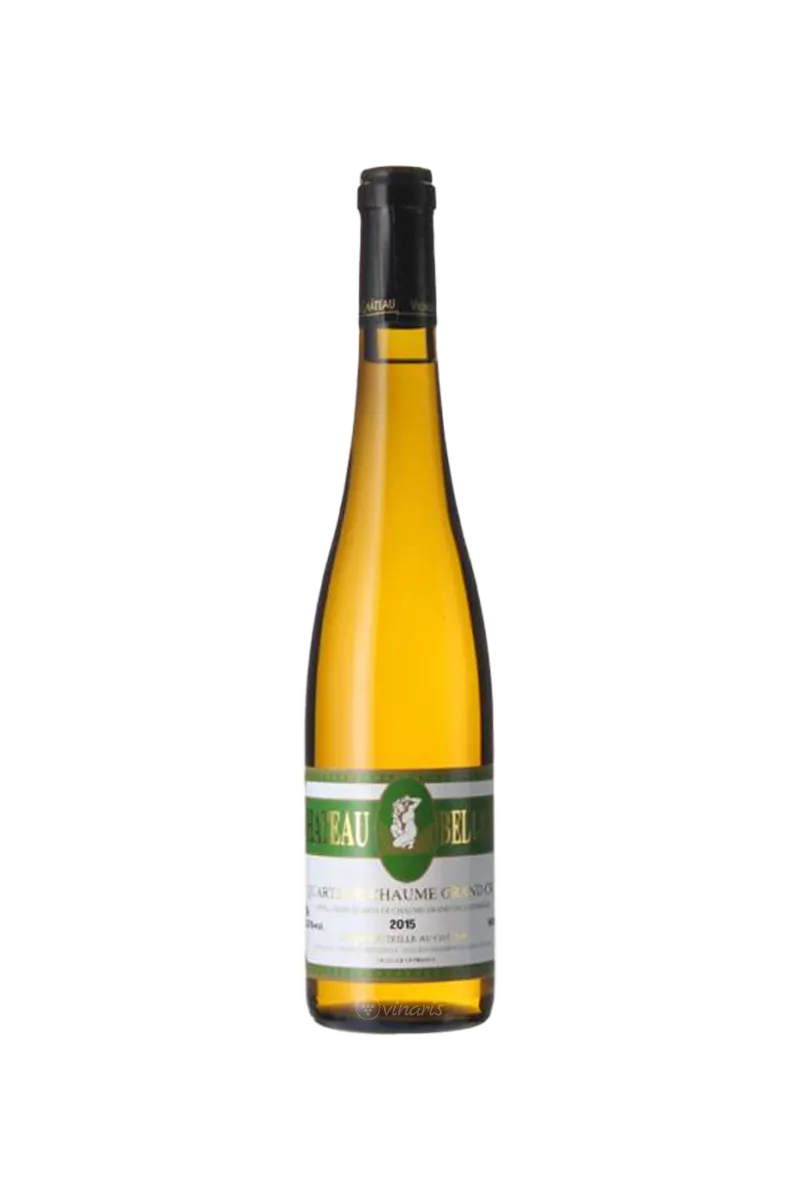


 Château Bellerive stands among the handful of historic estates that shaped the Quarts de Chaume appellation, now stewarded by Alain Château since 2004 with the late Denis Dubourdieu consulting. Its 12 hectares sit within one of France's most rigorous sweet wine terroirs — a ~40-hectare enclave above Rochefort-sur-Loire where steep south-facing slopes of decomposed sandstone, micro-granites, and Brioverian schists, combined with Layon morning mists, produce the noble rot essential to this style. Recognised in 2011 as the Loire's first Grand Cru, the appellation enforces a maximum yield of 20 hl/ha, a minimum must sugar of 298 g/l, and at least 85 g/l of residual sugar at bottling. 100% Chenin Blanc.
 The 2020 vintage was hand-harvested in successive passes targeting perfectly botrytised berries, then slowly fermented in 400-litre oak barrels and aged for 10 to 12 months with regular bâtonnage. Mid-August rains extended the ripening season, encouraging outstanding botrytis development. At 12% alcohol and 140 g/l residual sugar, it is bottled in 50 cl.
Quarts de Chaume Grand Cru 2020 by Château Bellerive
This sweet wine hails from the Loire Valley, specifically the Quarts-de-Chaume-Grand-Cru appellation in France. Produced by Château Bellerive, one of the four historic domains of this prestigious denomination—which gained Grand Cru status in 2011—the estate spans 12 hectares on steep south-facing slopes. The vineyards are situated over decomposed sandstone, microgranites, and Brioverian schists.
The 2020 vintage is crafted from 100% Chenin Blanc grapes. Harvesting was conducted manually through successive passes of hand-selected berries. In this year, mid-August rains facilitated exceptional development of noble rot (botrytis), a process encouraged by the frequent mists of the Layon river. Strict appellation rules limit yields to a maximum of 20 hl/ha and require a minimum must sugar richness of 298 g/l at harvest.
Vinification involves a slow fermentation in 400-liter oak barrels. The wine then undergoes aging for 10 to 12 months with bâtonnage (lees stirring). The resulting cuvée contains 140 g/l of residual sugar and reaches an alcohol level of 12% vol. It is presented in 50 cl bottles, reflecting the traditional format for this style.
The profile is defined by its rich sweetness balanced by the minerality of the schist soils and the precision afforded by the slow fermentation. The wine stands as a representative example of high-quality Loire sweet wines, combining the intensity of botrytized Chenin with careful oak integration. It offers a concentrated, textured experience typical of Grand Cru Quarts de Chaume, where noble rot complexity meets structured acidity and lees-derived richness.
Descripción generada por IA con conocimiento WSET. Solo orientativa.
Quarts de Chaume, one of the smallest appellations in the Loire Valley, was granted grand cru status in 2011. When its boundaries were drawn in the fifties, Bellerive — then in the hands of the Lalanne family — was one of the four estates around which the appellation was built: the appellation was traced, in part, along its vines.
Before that it had belonged to Louis Mignot, who set about making the wines of Quarts de Chaume known through the 19th century and the early 20th.
In 2004 it was bought by Alain Château, an industrialist who had made his money in printing, paper and packaging; his surname is, literally, Château. He took on Denis Dubourdieu as his adviser, professor of oenology at Bordeaux and owner of Doisy-Daëne in Barsac, who died in 2016.
There are 12 hectares of Chenin Blanc on the left bank of the Loire, on steep south-facing slopes, over decomposed sandstone, microgranites and Brioverian schist. The mists off the Layon bring noble rot. The rules set a maximum yield of 20 hl/ha and a minimum of 298 g/l of sugar at harvest, and picking is done in successive passes, berry by berry.
Alain Château also owns Château de la Guimonière, in Coteaux du Layon, and Château de Varennes, in Savennières: thirty-eight hectares across the three houses.
See all wines by Château Bellerive →