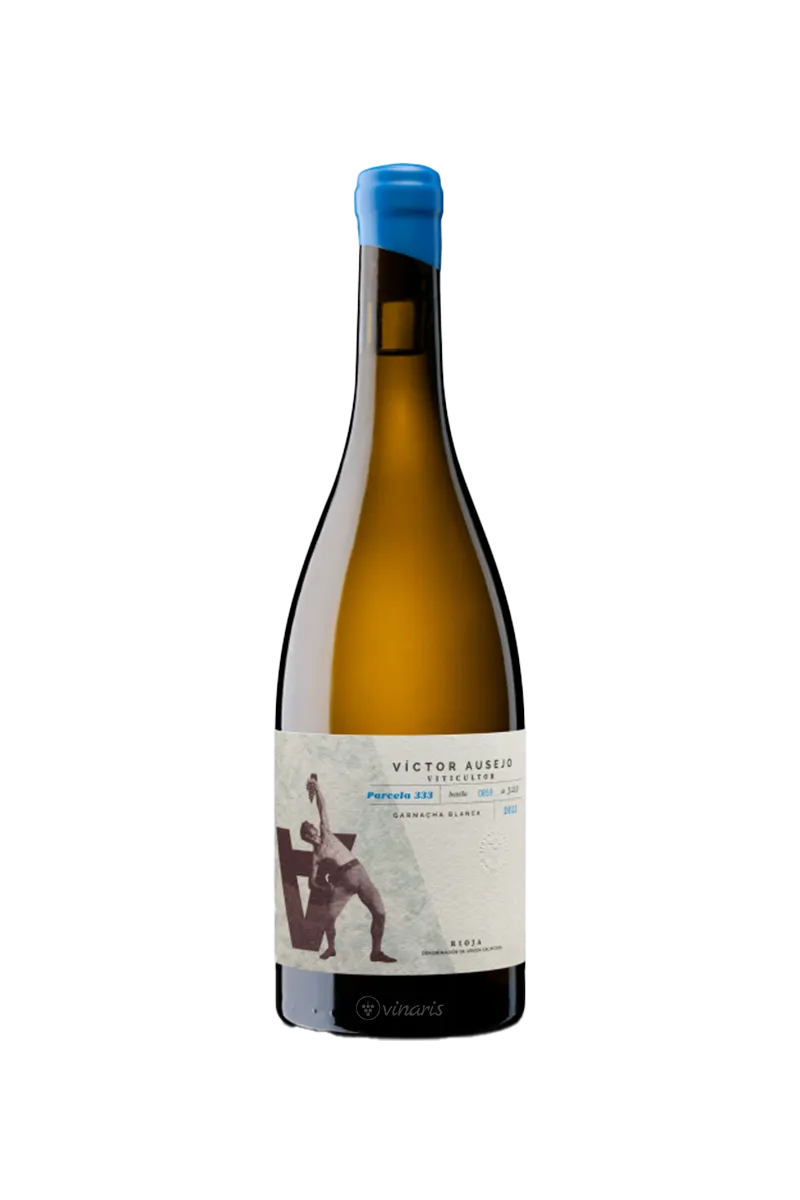





 Víctor Ausejo, DOCa Rioja. El Peinao parcel (2 ha), Clavijo, 546 metres altitude. Clay-ferrous soils with some alluvial areas. East-west facing. Sustainable viticulture: organic fertiliser, no herbicides, minimum tillage. 100% Garnacha Blanca.
 Hand-harvested in 15 kg boxes (21–22 September). Manual bunch selection in the winery. Gently pressed and cold-settled. Fermented and aged 8 months in stainless steel tank on lees with weekly battonage. Production: 3,212 bottles.

Wine Identification
Victor Ausejo Parcela 333 is a white wine from the renowned Rioja DOCa region in Spain, produced by winemaker Víctor Ausejo. The specific vintage is 2022.
Origin and Winemaking
This wine is crafted from 100% Garnacha Blanca grapes sourced from a single vineyard plot known as El Peinao, located in Clavijo. The vines are situated at an altitude of 546 meters with an east-west orientation. The soil composition is primarily clay-ferrous, with minor alluvial contributions. Viticultural practices are sustainable, utilizing organic manure, avoiding herbicides, and minimizing tillage.
The harvest was conducted manually in 15 kg crates on September 21–22. Upon arrival at the winery, bunches were hand-selected. The grapes underwent soft pressing followed by static settling. Fermentation and aging took place for eight months in stainless steel tanks while on the lees, with weekly bâtonnage (lees stirring). The total production for this vintage was 3,212 bottles.
Tasting Profile
As a Garnacha Blanca from Rioja, Parcela 333 is expected to reflect the freshness and aromatic intensity typical of the variety. The eight-month aging on lees with regular stirring suggests a textured, structured mouthfeel, likely offering creamy nuances alongside the fruit’s natural acidity.
Critical Reception
The wine has received positive critical attention:
Tim Atkin: 94 points
The Wine Advocate (Parker): 92 points
Overall Character
Victor Ausejo Parcela 333 represents a precise, site-specific expression of Garnacha Blanca. Through meticulous vineyard management and careful vinification involving lees aging, the wine aims to deliver complexity and texture while maintaining the varietal character inherent to its origins in Clavijo.
Descripción generada por IA con conocimiento WSET. Solo orientativa.
Víctor Ausejo grew up in Alberite, a village in the Iregua Valley eight kilometres south of Logroño. His family had vines, but as a young man he had no interest in wine and worked as a plumber. The construction crisis pushed him to reconsider: he completed a Higher Degree in viticulture and oenology in Logroño, trained at Vivanco and Gómez Cruzado — where he met Miguel Merino, who became his mentor — and in 2018 launched his own project from a converted family garage, with 400 bottles of barrel-fermented Garnacha Blanca.
The project centres on three owned parcels totalling around three hectares. El Peinao, near Clavijo, holds two hectares of Garnacha Blanca at 540 metres altitude, planted in 2016 from cuttings sourced at Remelluri. Los Pepones, in Sojuela, has 0.36 hectares of Garnacha Tinta from vines planted in 1950, at 650 to 800 metres on sandy soils surrounded by woodland. La Colorada, in Alberite, provides 0.5 hectares of Mazuelo (Carignan) planted in 1993 on ferrous clay. All three parcels are farmed without herbicides or systemic treatments — organically in practice, though without formal certification.
Ausejo's philosophy is that of a different Rioja: minority varieties rescued from near-extinction — Garnacha Blanca, Garnacha Tinta, Mazuelo — minimal intervention, no over-extraction, and balance and tension as guiding principles. He works with stainless steel tanks, a concrete egg, and French and Hungarian oak barrels of varying ages. The Parcela 333 Garnacha Blanca, fermented and aged in barrel and concrete egg, earned 95 points from Tim Atkin MW on its debut vintage, who named it "white wine discovery of the year." Decanter included Ausejo among the five standout producers in its Rioja Report 2026. Annual production is around 10,000 bottles, 60% of which is exported.
See all wines by Víctor Ausejo →